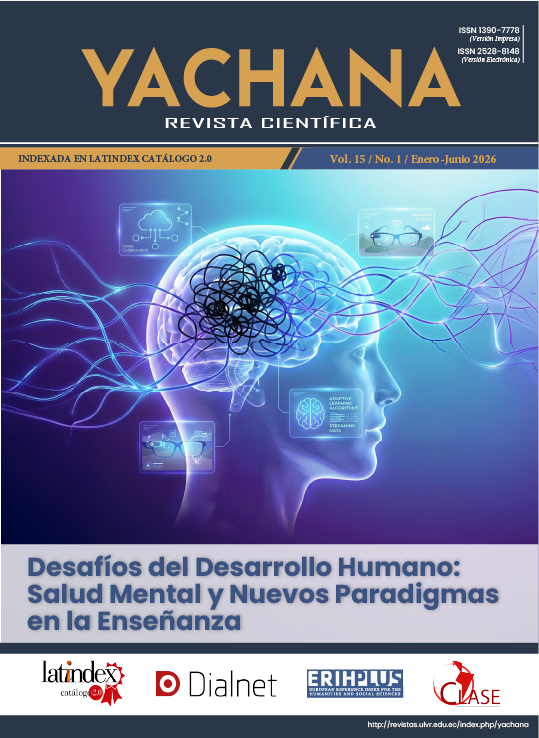
Inteligencia artificial y tecnologías emergentes aplicadas al cumplimiento de la “tercera misión universitaria”
DOI:
https://doi.org/10.62325/10.62325/yachana.v15.n1.2026.1048Palabras clave:
universidad, aprendizaje en línea, motivación, innovación educacionalResumen
El estudio analiza la relación entre neuroeducación, tecnologías emergentes y la tercera misión universitaria en la educación superior ecuatoriana. Se aplicó un enfoque no experimental, transversal y descriptivo-exploratorio con triangulación metodológica basada en observación estructurada, entrevistas y análisis documental, en 135 estudiantes de la carrera de Educación de la Universidad Metropolitana del Ecuador. Los resultados muestran altos niveles de compromiso (90%), colaboración (90%) y participación activa (85%), con una media general de 84,1% (DE = 3,4). El uso de tecnologías emergentes presentó mejor desempeño (87,3%) que la aplicación de principios neuroeducativos (81,9%). Las entrevistas confirmaron mejoras en motivación y personalización del aprendizaje mediante inteligencia artificial, mientras que el análisis documental evidenció coherencia con las políticas nacionales y los Objetivos de Desarrollo Sostenible. Se concluye que la convergencia entre neuroeducación e IA favorece la participación, el aprendizaje significativo y la proyección social universitaria.
Descargas
Citas
Aguado-García, J.-M., Alonso-Muñoz, S., & De-Pablos-Heredero, C. (2025). Using Artificial Intelligence for Higher Education: An Overview and Future Research Avenues. SAGE Open, 15(2). https://doi.org/10.1177/21582440251340352
Angrosino, M. (2007). Doing ethnographic and observational research. SAGE. https://tinyurl.com/4sdr95mb
Bowen, G. A. (2009). Document analysis as a qualitative research method. Qualitative Research Journal, 9(2), 27–40. https://doi.org/10.3316/QRJ0902027
Braun, V., & Clarke, V. (2006). Using thematic analysis in psychology. Qualitative Research in Psychology, 3(2), 77–101. https://doi.org/10.1191/1478088706qp063oa
British Educational Research Association. (2018). Ethical guidelines for educational research (4th. ed.). British Educational Research Association. https://tinyurl.com/35fsty6f
Compagnucci, L., & Spigarelli, F. (2020, December). The Third Mission of the university: A systematic literature review on potentials and constraints. Technological Forecasting and Social Change, 161, 120284. https://doi.org/10.1016/j.techfore.2020.120284
Creswell, J. W., & Plano Clark, V. L. (2018). Designing and conducting mixed methods research (3rd ed.). SAGE. https://tinyurl.com/57rdx442
Denzin, N. K. (2012). Triangulation 2.0. Journal of Mixed Methods Research, 6(2), 80-88. https://doi.org/10.1177/1558689812437186
Etikan, I., Musa, S. A., & Alkassim, R. S. (2016). Comparison of Convenience Sampling and Purposive Sampling. American Journal of Theoretical and Applied Statistics, 5(1), 1–4. https://doi.org/10.11648/j.ajtas.20160501.11
Field, A. (2018). Discovering statistics using IBM SPSS statistics (5th ed.). SAGE.
Gkintoni, E., Antonopoulou, H., Sortwell, A., & Halkiopoulos, C. (2025). Challenging Cognitive Load Theory: The Role of Educational Neuroscience and Artificial Intelligence in Redefining Learning Efficacy. Brain sciences, 15(2), 203. https://doi.org/10.3390/brainsci15020203
Guerrero, M., Urbano, D., & Fayolle, A. (2016). Entrepreneurial activity and regional competitiveness: Evidence from European entrepreneurial universities. The Journal of Technology Transfer, 41(1), 105–131. https://doi.org/10.1007/s10961-014-9377-4
Hamari, J., Koivisto, J., & Sarsa, H. (2014). Does gamification work? A literature review of empirical studies on gamification. In Sprague, R. (Ed.), Proceedings of the 47th Hawaii International Conference on System Sciences (HICSS), (pp. 3025–3034). https://doi.org/10.1109/HICSS.2014.377
Herrera, P., Huepe, M., & Trucco, D. (2025). Educación y desarrollo de competencias digitales en América Latina y el Caribe (LC/TS.2025/3). Comisión Económica para América Latina y el Caribe (CEPAL). https://tinyurl.com/22drdbb3
Howard-Jones, P. A. (2014). Neuroscience and education: Myths and messages. Nature Reviews Neuroscience, 15(12), 817–824. https://doi.org/10.1038/nrn3817
Ifenthaler, D., & Schumacher, C. (2016). Student perceptions of privacy principles for learning analytics. Educational Technology Research and Development, 64(5), 923–938. https://doi.org/10.1007/s11423-016-9477-y
Johnson, R. B., & Onwuegbuzie, A. J. (2004). Mixed Methods Research: A Research Paradigm Whose Time Has Come. Educational Researcher, 33(7), 14-26. https://doi.org/10.3102/0013189X033007014
Kallio, H., Pietilä, A. M., Johnson, M., & Kangasniemi, M. (2016). Systematic methodological review: Developing a framework for a qualitative semi‐structured interview guide. Journal of Advanced Nursing, 72(12), 2954–2965. https://doi.org/10.1111/jan.13031
Organización de las Naciones Unidas para la Educación, la Ciencia y la Cultura. (2021). Recomendación de la UNESCO sobre la Ciencia Abierta. https://unesdoc.unesco.org/ark:/48223/pf0000379949_spa
Pradeep, K., Anbalagan, R. S., Thangavelu, A. P., Aswathy, S., Jisha, V. G., & Vaisakhi, V. S. (2024). Neuroeducation: Understanding neural dynamics in learning and teaching. Frontiers in Education, 9, 1437418. https://doi.org/10.3389/feduc.2024.1437418
Radianti, J., Majchrzak, T. A., Fromm, J., & Wohlgenannt, I. (2020). A systematic review of immersive virtual reality applications for higher education: Design elements, lessons learned, and research agenda. Computers & Education, 147, 103778. https://doi.org/10.1016/j.compedu.2019.103778
Redecker, C. (2017). European framework for the digital competence of educators: DigCompEdu (Y. Punie, Ed.). Publications Office of the European Union. https://doi.org/10.2760/159770
Sailer, M., & Homner, L. (2020, March). The gamification of learning: A meta-analysis. Educational Psychology Review, 32, 77–112. https://doi.org/10.1007/s10648-019-09498-w
Salas-Pilco, S. Z., Yang, Y., & Zhang, Z. (2022). Student engagement in online learning in Latin American higher education during the COVID-19 pandemic: A systematic review. British journal of educational technology: journal of the Council for Educational Technology, 53(3), 593–619. https://doi.org/10.1111/bjet.13190
Secretaría Nacional de Planificación. (2021). Plan de Creación de Oportunidades 2021–2025. https://tinyurl.com/m3xwem3e
Taieb, S. (2024). Measuring the third mission of European universities: A systematic literature review. Society and Economy, 46(2), 147–167. https://doi.org/10.1556/204.2023.00030
Tokuhama-Espinosa, T. (2018). Neuromyths: Debunking false ideas about the brain. W. W. Norton & Company. https://tinyurl.com/2vkp9cxc
Tsay, C., Kofinas, A. K., Trivedi, S. K., & Yang, Y. (2019). Overcoming the novelty effect in online gamified learning systems: An empirical evaluation of learner engagement and performance. Journal of Computer Assisted Learning, 36(2), 128–146. https://doi.org/10.1111/jcal.12385
Xia, Q., Weng, X., Ouyang, F., Lin, T. J., & Chiu, T. K. F. (2024). A scoping review on how generative artificial intelligence transforms assessment in higher education. International Journal of Educational Technology in Higher Education, 21, Article 40. https://doi.org/10.1186/s41239-024-00468-z
Zawacki-Richter, O., Marín, V. I., Bond, M., & Gouverneur, F. (2019). Systematic review of research on artificial intelligence applications in higher education: Where are the educators? International Journal of Educational Technology in Higher Education, 16, Article 39. https://doi.org/10.1186/s41239-019-0171-0
Publicado
Cómo citar
Número
Sección
Licencia
Derechos de autor 2026 Yachana

Esta obra está bajo una licencia internacional Creative Commons Atribución-NoComercial 4.0.